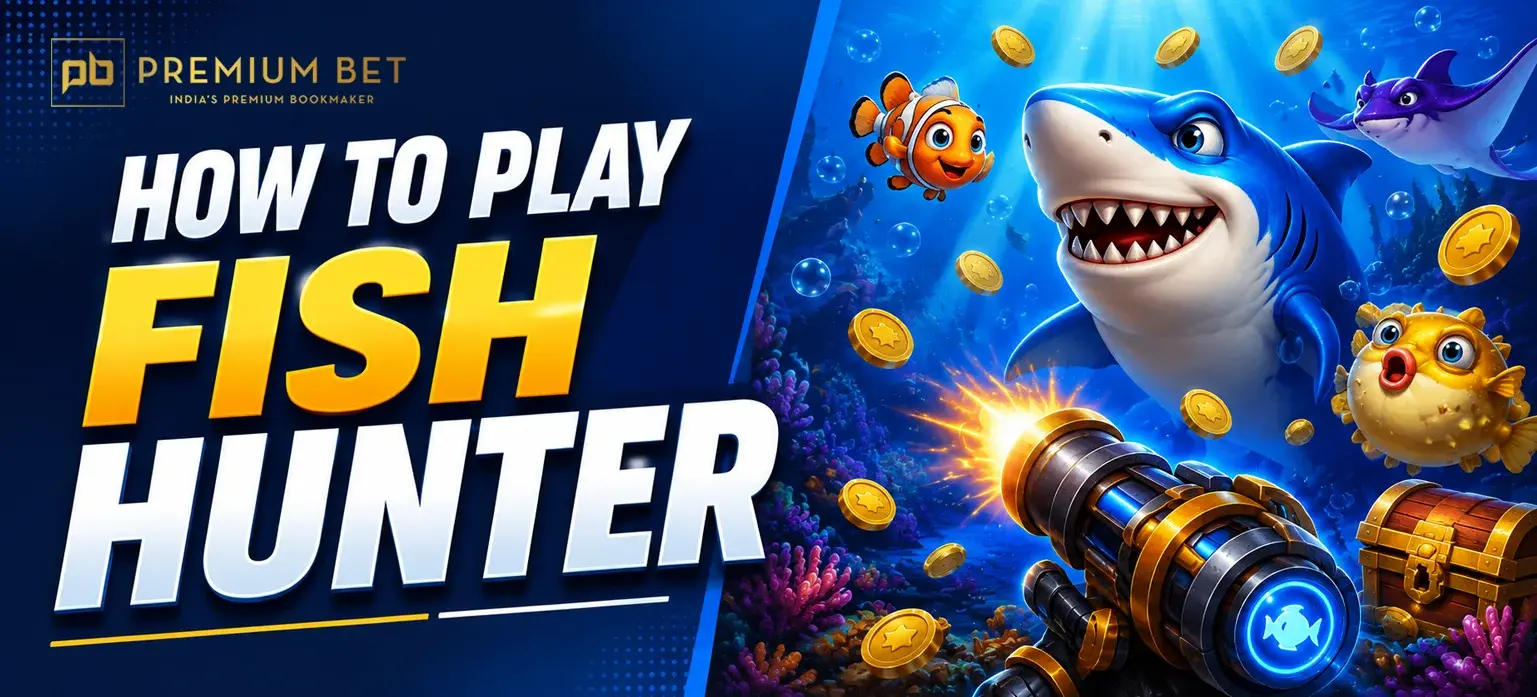
Fish Hunter is an arcade-style shooting game where you use a virtual cannon to catch fish swimming across the screen. Unlike slot games, you control when to shoot and how much you want to spend on each shot. The rules are simple, making the game easy for beginners to understand. According to Twin Win Games, 60–70% of Fish Hunter gameplay in 2026 occurs on mobile devices, underscoring how popular these games have become among online players.
This guide will explain how Fish Hunter works, how to play it, and the basic terms every beginner should know before getting started.
What Is Fish Hunter?
Fish Hunter is a multiplayer shooting game where players use a virtual cannon to catch fish and sea creatures for rewards. Every shot costs credits, while every fish offers a different reward value. Your goal is to spend your credits wisely and choose targets carefully.
Unlike many online casino games, Fish Hunter lets you interact with the game throughout every round. Instead of waiting for a result, you actively decide what to shoot and when to shoot it.
Most Fish Hunter games include:
- A cannon with adjustable power
- Fish worth different reward values
- Boss creatures with higher payouts
- Multiplayer tables
- Special weapons in selected game versions
A screen may contain twenty fish moving in different directions. Instead of firing at everything, you might wait until a medium-sized fish moves closer before taking your shot. You control every action, But, licensed Fish Hunter games still use a Random Number Generator (RNG) to decide when a fish is successfully caught.
Understanding this balance between player choice and random outcomes helps you build realistic expectations before you begin playing.
How Fish Hunter Works
Fish Hunter follows a simple cycle. You choose your cannon power, fire bullets at moving fish, and receive rewards whenever a fish is caught. Every bullet costs credits, so managing your balance is an important part of the game.
The table below explains the main parts of a typical Fish Hunter game.
| Feature | Purpose |
| Cannon | Fires bullets at fish. |
| Bullets | Each shot uses credits from your balance. |
| Fish | Every fish has a different reward value. |
| Boss Creatures | Harder to catch but usually offer higher rewards. |
| Cannon Power | Lets you change the value of each shot. |
| Multiplayer Mode | Allows several players to play on the same table |
| Special Weapons | Some games include lasers, bombs, or electric nets. |
Let’s assume your cannon is set to 5 credits per shot. Every time you fire, 5 credits are deducted immediately. If the fish is caught, you receive the reward linked to that fish. If it escapes, the credits used for those shots are lost.
Although the gameplay feels interactive, the final result of every successful catch is determined by the game’s RNG in licensed versions.
How to Play Fish Hunter Step by Step
Learning Fish Hunter is straightforward because every round follows the same basic process. Once you understand each step, you can focus on managing your credits instead of trying to keep up with the action on the screen.
Here is how a typical game works.
1. Select Your Cannon Power
Before you fire your first shot, choose how much you want each bullet to cost. Most games allow you to increase or decrease your cannon power at any time.
A lower setting lets you play longer with the same number of credits, while a higher setting spends credits more quickly.
When choosing your cannon level, remember to:
- Start with a lower setting.
- Increase power only when needed.
- Adjust your cannon during the game.
- Avoid using maximum power immediately.
Suppose you begin with 1,000 credits. A cannon that costs 2 credits per shot allows you to learn the controls without reducing your balance too quickly. After you become familiar with the game, you can decide whether increasing your cannon power makes sense.
Many beginners find it easier to learn the game by making small adjustments instead of changing to the highest setting right away.
2. Watch the Fish Before You Shoot
It is easy to start firing as soon as the game begins, but spending a few seconds watching the screen often leads to better decisions.
Fish move at different speeds and follow different paths. Some stay on the screen for several seconds, while others disappear quickly.
Before firing, pay attention to:
- Fish size
- Swimming speed
- Direction of movement
- Groups of fish
- Special sea creatures
A turtle moving slowly across the centre of the screen is usually easier to target than a fast-moving shark near the edge. Waiting for a better opportunity can help reduce unnecessary shots.
Taking time to observe the game also helps you decide which targets match your current cannon power.
3. Aim Carefully
Once you choose a target, keep your cannon focused on it instead of switching between multiple fish. Careful aiming helps reduce missed shots and makes better use of your credits.
Every bullet costs credits, whether it hits or misses.
A few simple habits can help:
- Follow one target at a time.
- Avoid firing into empty areas.
- Adjust your aim as fish change direction.
- Skip fish that are already leaving the screen.
Let’s say three small fish are swimming quickly across one side of the screen while a larger fish moves slowly through the middle. Following the larger target may give you a better chance to land several shots before it swims away.
Better aiming does not change the RNG, but it can reduce unnecessary spending.
4. Fire Your Shots
After your target moves into a good position, begin shooting. Every shot immediately uses credits from your balance.
Some fish are caught after only a few hits, while others remain on the screen much longer.
Keep these points in mind:
- Every shot costs credits.
- Missing a fish does not refund your credits.
- Larger fish may require more successful hits.
- Rewards are paid only after a fish is caught.
For example, suppose you fire five shots at a medium-sized fish using a cannon worth 4 credits per shot. You spend 20 credits in total. If the fish pays 60 credits, you finish with a higher balance than you started with for that target. If it escapes, those 20 credits are gone.
This balance between spending and possible rewards is one of the main parts of Fish Hunter.
5. Change Your Strategy During the Game
Fish Hunter is always changing. New fish appear, boss creatures enter the screen, and groups move in different directions. Using the same approach from start to finish does not always make sense.
Instead, adjust your decisions as the game changes.
For example, you may want to:
- Increase cannon power for larger fish.
- Lower your cannon level if your balance falls.
- Focus on fish that stay on the screen longer.
- Ignore targets that are about to disappear.
Imagine you have been targeting small fish when a group of larger sea creatures suddenly appears. You may decide to increase your cannon power for a short time and then return to your previous setting once those targets are gone.
Small changes like these can help you manage your credits more effectively throughout the game.
6. Use Special Features Wisely
Many Fish Hunter games include extra features that appear during gameplay. These vary by software provider, so every version is slightly different.
On PB77, you may find different Fish Hunter titles with their own special features and weapons.
Some common examples include:
- Bomb attacks
- Laser cannons
- Electric nets
- Freeze effects
- Auto-fire mode
For example, a bomb may remove several nearby fish at once, while a laser can hit multiple fish lined up across the screen. Before using these features, read the game’s help section so you understand how they work.
Knowing when special features appear can help you make better decisions without relying on guesswork.
7. Keep Track of Your Credits
The action in Fish Hunter moves quickly, making it easy to lose track of your balance. Checking your credits regularly helps you stay in control throughout your session.
A simple plan can prevent unnecessary spending.
Good habits include:
- Checking your balance every few rounds.
- Lowering cannon power when needed.
- Setting a spending limit before you begin.
- Stopping once your limit is reached.
For better understanding, if you start with 2,000 credits and notice that your balance has fallen to 1,200, it may be time to reduce your cannon power instead of continuing with the same betting level.
Managing your credits is one of the simplest ways to enjoy Fish Hunter while keeping your spending under control.
In the next section, you’ll learn how fish values work, why some targets pay more than others, and what beginners should know before choosing which fish to shoot.
What Are Fish Values in Fish Hunter?
Every fish in Fish Hunter has a different reward value. In most games, smaller fish are easier to catch but offer lower rewards. Larger fish and special sea creatures usually pay more because they are harder to catch.
The reward values are listed in the game’s paytable. Checking the paytable before you start helps you understand which targets match your budget and playing style.
Here are the most common target types:
- Small fish – Lower rewards and easier to catch.
- Medium fish – Balanced rewards and moderate difficulty.
- Large fish – Higher rewards but require more successful hits.
- Boss creatures – Rare targets that usually offer the highest payouts.
- Special objects – Some games include treasure chests or bonus creatures with separate rewards.
Let’s say you see a small clownfish and a giant shark on the screen. The shark may offer a much bigger reward, but you might spend many more credits trying to catch it. In some situations, catching several smaller fish can be a better choice than chasing one large target.
Choosing the right target depends on your current balance, your cannon power, and the way the game is progressing.
Tips for Beginners
Fish Hunter is easy to learn, but a few good habits can help you avoid unnecessary mistakes. The goal is not to catch every fish. Instead, focus on using your credits carefully and understanding how the game works.
As you spend more time with the game, you will become more comfortable with fish movement, cannon settings, and different game features.
Here are some useful beginner tips:
- Start with a low cannon level.
- Watch fish movement before shooting.
- Learn the paytable before chasing larger fish.
- Increase cannon power gradually.
- Take breaks during longer sessions.
- Set a spending limit before you begin.
Suppose you begin with 1,500 credits. Rather than using the highest cannon level, spend your first few rounds learning how different fish move across the screen. Once you feel comfortable, you can adjust your cannon power based on the targets that appear.
Many beginners also skip the game’s help section. Taking a few minutes to read it can explain special features, bonus weapons, and other rules that vary between Fish Hunter titles.
Common Mistakes New Players Make
Most beginners make similar mistakes because the game moves quickly. Knowing these mistakes in advance can help you make better decisions and manage your credits more carefully.
Here are five common mistakes to avoid.
1. Starting With the Highest Cannon Power
A stronger cannon also means every shot costs more credits. Many new players spend their balance too quickly because they choose the maximum setting from the beginning.
Remember these simple points:
- Higher power uses more credits.
- Bigger bullets do not guarantee better results.
- You can increase power later.
- Lower settings are usually better for learning.
Two players may begin with the same balance. The player using a lower cannon level often has more credits left after several rounds because each shot costs less.
2. Shooting at Every Fish
When dozens of fish appear together, firing in every direction may seem like a good idea. In reality, this usually leads to unnecessary spending.
Instead, try to:
- Focus on one target.
- Follow its movement.
- Avoid changing targets constantly.
- Ignore fish leaving the screen.
For example, a medium-sized fish swimming slowly through the middle of the screen may be a better target than several small fish moving quickly in different directions.
Being selective often helps you use fewer bullets.
3. Chasing Every Boss Creature
Boss creatures usually offer the largest rewards, but they are also the hardest targets to catch.
Many beginners spend too many credits trying to catch one large creature without considering the cost.
Keep these points in mind:
- Boss creatures need more successful hits.
- They may leave the screen before being caught.
- Smaller fish can provide steadier rewards.
- Larger rewards also involve greater risk.
For instance, if a giant sea dragon appears just before leaving the screen, it may be better to continue targeting fish that remain visible for longer.
Sometimes choosing not to shoot is the better decision.
4. Ignoring Your Credit Balance
Fish Hunter moves quickly, making it easy to forget how many credits you have left.
Checking your balance regularly helps you decide whether it is time to reduce your cannon power or stop playing.
Good habits include:
- Check your balance every few rounds.
- Lower your cannon level when needed.
- Set a spending limit before playing.
- Stop once that limit is reached.
If your balance falls much faster than expected, reducing your cannon power may help you play longer without increasing your spending.
5. Thinking a Fish Is “Due” to Be Caught
Some players believe that a fish becomes easier to catch after surviving many shots. This is a common misunderstanding.
Licensed Fish Hunter games use RNG, so previous shots do not affect future outcomes.
Keep this in mind:
- Every shot is independent.
- Previous misses do not improve your chances.
- No player can predict the next result.
- Random outcomes remain random.
For instance, a shark that has survived fifty shots is not automatically more likely to be caught on the fifty-first shot.
Understanding how RNG works helps you avoid unrealistic expectations.
Does Skill Matter in Fish Hunter?
Many beginners wonder whether Fish Hunter is based on skill or luck. The answer is that both play a role.
Your decisions affect how you manage your credits, but the game’s RNG decides when a fish is successfully caught.
Your skill can help you:
- Choose suitable targets.
- Manage your cannon power.
- Avoid wasting bullets.
- Control your spending.
- Understand game features.
Imagine two players start with the same number of credits. One player fires constantly without aiming. The other waits for better targets and adjusts cannon power when needed. Even though both players face the same RNG, the second player may use their credits more efficiently.
Good decisions improve your gameplay, but they do not change the random outcome of each shot.
Understanding RTP in Fish Hunter
RTP stands for Return to Player. It shows the percentage of total wagers that a game is designed to return over a very large number of rounds.
Many beginners misunderstand RTP because they think it predicts individual results. It does not.
Here are the basics:
- RTP is shown as a percentage.
- It is calculated over millions of rounds.
- It is a long-term mathematical average.
- Individual sessions can be very different.
- Different Fish Hunter games may have different RTP values.
For instance, a game with a 97% RTP is designed to return about ₹97 for every ₹100 wagered over time. This does not mean you will receive ₹97 back after spending ₹100 during one session.
RTP is useful for comparing games, but it should never be treated as a guarantee.
Fish Hunter vs Slot Games: What’s the Difference?
Fish Hunter and slot games may both use RNG. But, the way you play them is very different.
Fish Hunter involves active decisions throughout the game, while slot games focus on spinning reels and waiting for the outcome.
| Fish Hunter | Slot Games |
| You aim and shoot. | You spin the reels |
| You choose your targets. | You wait for symbols to land. |
| Several players can join one table. | Most games are single-player. |
| Cannon power can be changed during play. | You usually change only your wager. |
| Some games include special weapons. | Bonus rounds are triggered by symbols. |
Imagine you have ₹500 to play with. In a slot game, you simply choose your bet and press spin. In Fish Hunter, you decide which fish to target, when to shoot, and whether to change your cannon power during the game.
Neither game is better than the other. It depends on the style of gameplay you enjoy.
Conclusion
Fish Hunter is easy to learn because the controls are simple. But understanding the rules can help you make better decisions. Learning how cannon power works, checking fish values, managing your credits, and understanding RTP all help you play with realistic expectations.
Although you choose when to shoot and which targets to follow, licensed Fish Hunter games still use RNG to determine the final outcome of every catch. Before starting a game, take a few minutes to read the paytable and game rules, so you know how its features work. If you decide to play on PB77, always treat Fish Hunter as entertainment and play within a budget that is comfortable for you.
Frequently Asked Questions
1. Can you win consistenly in Fish Hunter?
No. Licensed Fish Hunter games use RNG to determine successful catches. Good credit management and careful target selection can improve how you play, but they cannot guarantee rewards.
2. Which fish should beginners target first?
Beginners should usually focus on small and medium-sized fish. They are generally easier to catch and help you learn the game before targeting larger creatures.
3. Is Fish Hunter available on mobile devices?
Yes. Most modern Fish Hunter games are designed for Android phones, iPhones, tablets, and desktop computers, allowing you to play on different devices.
4. Does increasing cannon power improve your chances?
Increasing cannon power increases the value of each shot, but it also uses more credits. It does not guarantee that a fish will be caught, because licensed games still rely on RNG to determine outcomes.